Reviews
A Thousand Words Review
Radium Girls is a gripping drama, based on the true story of female factory workers poisoned by radium-based paint in 1920s New Jersey. The play centres on three young women hired by the U.S. Radium Corporation to paint watch and instrument dials, instructed to sharpen their brushes by licking the bristles before each stroke. Beneath the glow of innovation lies deceit and tragedy, as science, business, and ambition combine in a story both timely and timeless.
D.W. Gregory’s script, written with warmth, wit, and a sharp moral conscience, examines the commercialisation of science, the exploitation of hope, and the cost of progress measured in human lives.
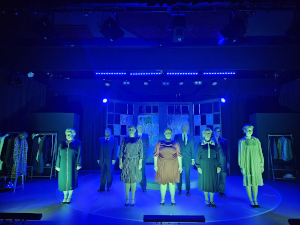
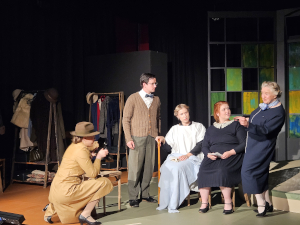
Director Kym Clayton presents Radium Girls in a consciously Brechtian manner. He invites audiences to think critically, rather than simply lose themselves in the story, aligning with Brecht’s own call for audiences to “observe rather than immerse.” The production’s aesthetic choices—direct address, visible scene changes, minimal props, and deliberate use of costume racks along the wings—reinforce that sense of theatrical transparency. With nine actors portraying over forty characters, Clayton’s direction ensures clarity, contrast, and sustained audience engagement throughout a demanding and complex narrative.
At the heart of the story is Grace Fryer, portrayed with remarkable emotional depth by Lucy Johnson. As the lone survivor determined to seek justice, Johnson anchors the play with understated power. Her transformation—from a hopeful young worker proud of her glowing handiwork to a determined woman confronting systemic failure—is both heartbreaking and inspiring. The gradual deterioration of her health, supported by impressive makeup design, is particularly moving in Act Two. Johnson’s work is full of empathy and purpose, especially in the play’s closing moments, which are both quietly devastating and profoundly human.
Adam Schultz delivers a layered portrayal of Arthur Roeder, the president of U.S. Radium Corporation. His performance balances charm, intellect, and denial, illustrating the devastating impact of moral blindness. Schultz resists the temptation to play Roeder as a straightforward villain; instead, he humanises him as a man trapped by his own ambition, conviction, and fear. His nuanced performance ensures that audiences feel reluctant pity rather than outright hatred—a difficult and commendable feat.
Among the ensemble, Scott Battersby stands out for his versatility, tackling seven very different roles, including Dr. Drink, a fussy Harvard hygienist; Charlie, a corporate executive desperate to contain bad publicity; and a gentle cowboy hopelessly enamoured with Grace. Each role is defined by distinct vocal and physical characteristics, making Battersby’s performance a masterclass in adaptability.
Andrew Horwood also impresses across five sharply contrasted roles. His portrayal of Edward Markley, the coldly pragmatic corporate lawyer, contrasts powerfully with remorseful Dr. Von Sochoky, founder of The U.S. Radium Corporation and creator of the luminous paint. Horwood’s comic turn as the Venecine salesman further demonstrates his range, bringing moments of humour that balance the drama’s intensity.
Aled Proeve takes on four roles—Tom (Grace’s loyal boyfriend), a reporter exchanging witty repartee with Nancy Jane Harlan, attorney Raymond Berry (representing the wronged dial painters), and Dr. Knef, the dentist who first suspects the connection between jaw decay and radium exposure. Each portrayal serves a clear purpose within the story’s moral and emotional tapestry, with Proeve distinguishing them through careful variation and intent.
Deborah Proeve, who shares the stage with her husband Aled, shines across five characters. Her standout performances include Irene Rudolph, the first of the dial painters to die, and Miss Wiley, a key activist with the New Jersey Consumer’s League who champions the girls’ case. Deborah’s graceful physicality and crisp diction lend emotional precision to each role, ensuring all feel lived-in rather than superficial.
Joanne St. Clair steps expertly between five personas, most notably Mrs. Roeder—whose quiet complicity mirrors her husband’s—and Marie Curie, whose misplaced scientific confidence takes on tragic irony in retrospect. St. Clair portrays both women with distinct voices and presences, embodying two faces of the early 20th-century mindset: one domestic, one intellectual, both ultimately compromised by systemic denial.
Deborah Walsh’s five roles, including Mrs. Fryer (Grace’s devoted mother), journalist Nancy Jane Harlan, and the officious factory supervisor Mrs. MacNeil, are all impeccably defined. Walsh’s brisk pacing, articulation, and emotional clarity make each appearance memorable. She finds humour and humanity in unexpected places—balancing the play’s serious subject matter with lightness where needed.
Rounding out the ensemble, Veronika Wlodarczyk makes a lasting impact through her five portrayals, most notably as Kathryn, Grace’s best friend, whose tragic death at only twenty-five underscores the terrible human toll. Despite limited stage time, Wlodarczyk’s sincerity and presence ensures her other roles are profoundly felt throughout the second act.
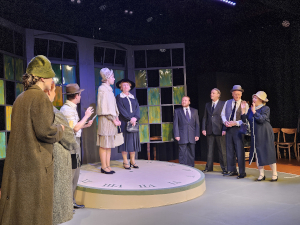
The production’s visual world amplifies its themes beautifully. The stage is dominated by a tilted clock face on a platform—a haunting emblem of time and decay—sitting upon a second dial below. This striking set design immediately draws the eye, working symbolically as well as practically. Costume racks along the wings are cleverly integrated into the play’s action, reinforcing Clayton’s stylistic transparency. The lighting design employs cool blue hues to mark moments of revelation, while the ominous ticking of the sound design serves as a constant reminder of mortality and inevitability.
Transitions between scenes are smoothly executed, though occasionally a slightly brisker rhythm might have maintained stronger narrative drive. The overall flow remains tight given the play’s ambitious, multi-year timeline. Clayton’s direction ensures emotional clarity without sacrificing thematic complexity.
The performance space contributes to the experience. Galleon’s cabaret-style and raked seating options both offer excellent sightlines, helping maintain intimacy even amid the play’s sweeping historical scope. The production invites audiences not merely to observe but to reflect, succeeding in its Brechtian intent.
By its conclusion, Radium Girls achieves something rare—a historical drama that feels urgent, relevant, and profoundly moving. Every element, from Clayton’s focused direction to Gregory’s acerbic yet compassionate script, reinforces the resilience of ordinary individuals confronting systemic injustice.
Galleon Theatre Group once again proves its capacity for ambitious, intelligent storytelling. Radium Girls is a triumph of ensemble craft—sharp, human, and thought-provoking—a poignant reminder that behind every “miracle discovery” lies the cost of those who first dared to believe.
Reviewed by Andrew Broadbent, 25th October 2025.
GLAM Adelaide Review
Based on true events, the Radium Girls were the female workers who died from radium poisoning caused by their workplace between 1917-1926. In this narrative, the U.S. Radium Plant held government contracts with the military to paint luminous watch dials, the benefit of using radium-based paint being that it glowed continuously. Teenagers and young women were hired for the job, and they were taught to mould the bristles with their mouth to maintain a fine point. Over time, their health deteriorated, and they sought to discover the reasons why.
With evidence kept hidden from the public by the factory, its doctor, and others that stood to financially gain from ignoring their plight, their horrific health issues and concerns were dismissed and took years to prove. In time, their refusal to stay silent — along with a sympathetic public made aware through the actions of a compassionate press — helped them find a lawyer to take on their case.
Director of Radium Girls, Kym Clayton used the Brechtian style of theatre, which includes a theatrical technique known as Verfremdungseffekt, the purpose of which is to prevent audiences from becoming too emotionally absorbed in the characters. This was achieved by using simple props, having actors play multiple roles, and placing all the costumes onstage. Built into the script at regular intervals were two reporters who addressed the audience directly, giving time stamps and brief updates on the case. This further reminded us that we were watching a play.
As a result, you stay a bit emotionally distant from the characters’ personal tragedies and even the romance between Grace and Tommy. Instead, you feel more of the anger at how unfair and unjust their situation was, and the themes being presented. Considering what the girls went through happened a century ago – and that these same corporate tactics still happen today – you leave the theatre questioning why nothing has changed. I feel angry just thinking about it, even as I write this review a day later!
The focus on Grace Fryer (Lucy Johnson) was pivotal in emphasising the themes. Although Irene (Deborah Proeve) and Kathryn (Veronika Wlodarczyk) fought alongside her, it was Fryer who led the fight. Johnson did a fantastic job showing the shift from obedient worker to being a strong and angry fighter in her posture and demeanour, simultaneously with declining health. On several occasions was often unsupported by those around her and even pressured by her mother (who guilted her with the financial struggles caused by her declining health). Johnson’s depiction of Grace made her story powerful to watch, as you fully felt both the sadness of her reality, but saw the resilience that kept her going.
What I felt shocked by was just how long these types of struggles have been going on. This historical story remains relevant today, and the production successfully forces a reflection on how little has changed in corporate ethics over the past century.
Reviewed by Rebecca Wu 24/10/2025
Stage Whispers Review
Radium Girls, presented by Galleon Theatre Group, narrates the horrific events which unfolded at the U.S. Radium Factory in Orange, New Jersey in the 1920’s. These factories were established across the United States to produce watches and military dials painted with a radium-based paint to glow in the dark.
Young women, hired because of their dexterity and small hands, worked, not knowing that by licking the brushes repeatedly between their lips, they were condemning themselves to slow deterioration and death, by radium poisoning.
The first death occurred in 1922, followed by many others as the women's health rapidly declined. We discover throughout the course of the play, the causes of death were frequently covered up or mislabelled as the company fought to hide the evil lurking beneath. Girls were instructed to use this “lip pointing” practice by their employers, who ultimately were responsible for their agonising ends.
Playwright DW Gregory pulls no punches in this script. It is heavy subject matter and can be wordy in places but is well researched and cleverly addresses issues which are of relevance today. We are confronted with the not so ethical decisions of corporate executives, medical and scientific professionals and the role of big companies in looking after the health of their workers. The cases brought to court as a result of the girls speaking out in the ‘20s, were instrumental in establishing occupational laws, mandating safety protective gear for workers and more precautions for staff wellbeing.
Due to the nature of the writing, jumping from scene to scene, with multiple blackouts, set changes and cast members playing many roles, this script presents a particular challenge for any director.
Kym Clayton, a talented director in Adelaide theatre, has used a Brechtian style approach in building the bridge between the actors and the audience. Brecht – style theatre is about connection, building a call to action for the audience to think about their own roles in societal change, and draw parallels with modern issues. This concern and reflection were certainly brought to the fore in this reviewer.
It was the mechanics of this play that brought some discomfort. Whilst staging a play which in true Brecht style is episodic, I felt that the silence between scene changes could have been filled by projection or ambient sound or music. Having the clothing racks onstage allowed for quick costume changes and the actors did their very best to make these and set changes as smooth as possible but I hope with time the pacing will improve.
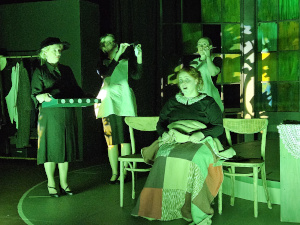
The set itself was simple, a giant clock face on a rake dominating the stage and grimy factory windows providing a minimalist playing space. Simply by bringing on tables and chairs we found ourselves in different time periods and spaces. Lighting by Trish Winfield was skilful - the eerie green glows created to remind us constantly of the ever-present poison.
The play focuses on two main characters - Grace Fryer, played by Lucy Johnson, and U.S. Radium president Arthur Roeder, played by Adam Schultz. Both actors did a solid job. Johnson is Grace, the radium worker who becomes ill and starts to question the cause of the sickness impacting herself and her co- workers. She is particularly good in Act Two as she confronts doctors and lawyers who constantly try to push back against her claims. She truly shows her mettle as she fights to be heard. I did feel some more evidence of her developing disease in her physicality was needed however, in Act One.
Schultz’s Roeder was interesting and we saw the contrast between him as the company manager and family man clearly, but I felt at times the character development needed a little more work. Having said that it is acknowledged that in such short-burst scenes this is a challenge.
Aled Proeve played his four roles with skill - good contrast between each. I particularly enjoyed the contrast between ‘Tom’ the fiancé and the reporter scrambling to be the most sensational. Clever characterisation.
Deborah Walsh and Joanne St Clair brought their substantial stage experience to the play in many roles. Both switch accents with aplomb and their portrayal of each character (of many) were distinct and cleverly crafted. St Clair’s Marie Curie, and Mrs Roeder showed great skill in accent work and emotive acting. Walsh’s wonderful Sob sister, very reminiscent of Mary Sunshine, was a delight as was her officious factory supervisor with a great Scottish accent!
Andrew Horwood, likewise, showed his broad experience through multiple characters - a particularly well developed and executed one being that of smoothly cynical lawyer Edward Markley. Wonderful work.
Scott Battersby, like all cast members played many characters with great skill, but was particularly excellent as C.B. Lee, Roeder’s right-hand man. His genial love smitten cowboy was a highlight moment.
Deborah Proeve also was sound in all her characters. She displayed great ability in distinguishing between the two characters of Irene and Miss Wiley, in body language and manner (although not perfectly heard at times as Miss Wiley).
Veronica Wlodarczyk as Katherine was able to portray the youthful optimism and fun when working in the factory and contrasted this well against her other characters, particularly the Society woman.
Whilst the show can be heavy at times, there are some lighter moments that bring the humanity into what is a very depressing storyline. This play resonates today, as we have seen the lack of care for workers and people in general, repeated in the fossil fuel industries, forever chemical companies and tobacco industry as attempts to cover up and obfuscate the truth have historically occurred.
We leave Radium Girls enraged that this horror occurred, but empowered to speak out to ensure companies know we are watching.
Reviewed by Shelley Hampton 25/10/2025
Theatre Association of SA (TASA) Review
Corporate greed and the mistreatment and silencing of workers is a tale as old as time, manifesting today in the form of the Bezoses and Musks of the world. D.W. Gregory’s Radium Girls turns the dial back to the early 20th century and the women who fought for recompensation after suffering devastating illness from working in factories painting luminous watches with the radioactive element radium. Galleon Theatre Group has commendably and respectfully retold this unsettling chapter of history and ensured that no meaning is lost on the audience.
Kym Clayton has achieved this in his careful direction with astute use of a Brechtian approach that forces the audience to confront the truth of the play. He and his team have cohesively coordinated all production elements: the set, constructed by Clayton, David Cuppleditch and Malcolm Wilkinson, emulates a bleak factory setting with dirty glass windows and uses wheeled tables that make for smooth scene transitions. A platform painted as a clock forms the centrepiece, upon which the corporate overlords plan to mislead the public and avoid responsibility. This, coupled with the ever-ticking sound effect that plays in the background of many scenes, managed by Marcel Gussmann, Tim Hall and Warren McKenzie, effectively conveys the borrowed time the women are working with, their fate sealed the first time they picked up a brush. The use of lighting bars to create a green, radioactive glow and ultraviolet lights, skilfully designed and operated by Trish Winfield, build an uncomfortable atmosphere and make for an unforgettable final beat of the performance. There were a few seemingly missing technical elements that were mentioned in dialogue, such as a name on a gravestone and a blackened hand, but these did not ultimately detract from the intensity of the production.
The cast must be commended for this marathon of a play. Most actors played several roles – in keeping with the Brechtian style – and none left the stage the whole time, constantly at the ready for quick costume changes and scene transitions. The precision they maintained throughout the entire performance is a testament to their focus and Clayton’s direction. Admittedly, the script didn’t provide many opportunities for them to shine in the exposition-heavy first act, but they didn’t pull their punches in the second.
Lucy Johnson was a warm and steadfast conduit for the audience as the protagonist Grace, through whose eyes we perceived the injustices these women endured. Johnson portrayed her character with strength, showing both her unjust suffering and utter conviction in her refusal to back down. Adam Schultz as the conflicted antagonist Roeder was brilliant, showing us a dark descent into guilt while being too deep in to back out. Despite barely speaking to one another, the tension between the two was palpable. The other actors all skilfully switched between several roles which are too numerous to name, so I will stick to the highlights: Scott Battersby as Lee and Andrew Horwood as Markley personified the corporate corruption and denial well; Aled Proeve was charming as Grace’s desperately optimistic fiancé; Deborah Walsh carried off the determined reporter Nancy Jane Harlan with fervour (an audience favourite); Veronika Wlodarczyk and Deborah Proeve as the factory workers Kathryn and Irene had great chemistry and set the unsettling tone right from the opening as they joyfully played with radium; and Joanne St Clair as the morally-driven Mrs Roeder was captivating – the final scene between her and her on-stage husband Schultz was particularly powerful.
Clayton and Galleon Theatre Group have assembled a truthful and powerful production that presents a dark chapter of history that still uncomfortably resonates today.
Reviewed by Ben Proeve 24/10/2025
The Clothesline Review
The magic of electric light was all around, with science ushering in more new inventions to fundamentally shift society. In this bold era, radium was even touted as a miracle cure for all kinds of illnesses! The teenage girls would come home from working with it and glow in the dark: their hair, clothes and shoes. It appeared you could harness the power of the stars. Perhaps its pernicious popularity still echoes today in the vast array of wonder drugs pushed by ‘big pharma.’
The astonishing depth and breadth of talent in Adelaide theatre is on full display in Radium Girls – the latest offering from Galleon Theatre Company. The show is brilliantly brought to life by this tight ensemble of experienced actors, who each handle a range of characters with consummate professionalism. This entails switching roles in moments, often literally turning around to adopt a different persona for the next scene.
They accomplish this by the clever technique of letting these changes happen in full view at the side of the stage. With minimum costume and prop changes, it relies on the finely-honed skills of the cast. This allows for smooth scene changes and the crisp flow of the action.. And by keeping everything open on stage it also fits perfectly with the main theme, that of exposing the need of justice for workers’ rights.
The script by D. W. Gregory gives the main characters time to develop and demonstrate the complex nature of their inner struggles to remain true to their principles while listening to the conflicting voices of their closest relationships. The American accents are kept consistent throughout both acts, no mean feat in such a diverse group. This contributes considerably to maintaining the setting of this historical play, and re-creating the frenetic world of New York city. The story is gradually revealed from both sides: both from the workers and their families as well as from the bosses’ perspective. With the stakes a matter of life and death, they could not be higher. The drama builds into the second act to increasing emotional heights.
To ensure this tension continues to rise until the final climax is a considerable accomplishment by all involved. Credit is due to the deft direction by Kym Clayton, strongly supported by fine performances by all. Likewise, the crew behind the scenes do an excellent job of making this a seamless production. The stage design for example evokes the period beautifully, drawing on movies and art from the time.
There is more than enough to engage, and resonate with, the audience. The extremes of unimaginable money and power concentrating in the hands of less people is even more present today. With our trust in traditional institutions cracking if not crumbling, this is a powerful metaphor for the current crises we face. The Brechtian style of theatre they choose to use in mounting this play means we as the audience feel directly involved in the action. We too are confronted by their choices: to take a stand for your beliefs, despite the opposition, or to compromise when the pressures come from all sides, including that of imminent death.
5 Stars
Reviewed by David Cronin 24/10/2025
What's the Show Review
There’s something different about a theatre performance based on real stories. Radium Girls tells the story of the young girls and women who were unknowingly poisoning themselves at work every day. Being taken advantage of by the men of the company and the physicians they thought they could trust, we follow the story of Grace and her friends Irene and Kathryn as they fight for their voices to be heard and their dues paid. Do not worry if you don’t know much of the story; the script and cast will provide you with context and hold your hand through this fight for justice.
As we follow Grace’s story, we meet a smattering of interesting characters who brighten the stage. The cast list is smaller than the character list, so you can expect to see some faces on more than one character, but with speedy costume changes – paired with some impressively quick accent changes – you’re never confused as to who is who. If you find yourself needing a guide, the well-formatted program the company has on offer provides a helpful cast list.
And a rather professional cast, I feel is important to note. With opening night jitters of missed lighting cues, the cast didn’t allow it to deter them, delivering their lines as though nothing were amiss. Missed cues aside, the lighting was strong, showing an array of colours to aptly represent the mood for each scene. Showing off the simple yet powerful stage which, at first glance, shows little more than some stunningly coloured green windows and a giant analogue clock face. This versatile stage will transform from the US Radium Company’s factory, to Grace’s family dining room, to a courthouse, and more without missing a beat, and never leaving room for confusion.
It’s easy to find yourself immersed within the story, but every now and then a monologue will take you by surprise, leaving you wide-eyed. With moments carefully chosen to address the audience, don’t be surprised if you leave and find yourself unable to stop thinking of particularly emotional moments. Even with these crafted moments to make the audience think, the show itself is not hard to follow, and easy to feel a connection with every cast member on the stage (no matter which character they are portraying).
The only thing I wish had been utilised more was the glowing radium. I spotted some glowing aprons, but seeing some glowing shoe soles, watches on characters, or paintbrushes would’ve been a treat. Otherwise, everything else was perfectly orchestrated for every character’s individual personality, from their accents and body language to their tailored costumes. The stage was used to its potential, with little to no dead space in any scene, the costumes matched the era, the cast supported each other with excellent chemistry, it was engaging, and the sound effects didn’t overshadow the cast.
A thought-provoking show, the story of the radium girls will remain an important retelling, and Galleon Theatre Group has provided us with a wonderful rendition.
Reviewed by Nicole Pomeroy 24/10/2025